
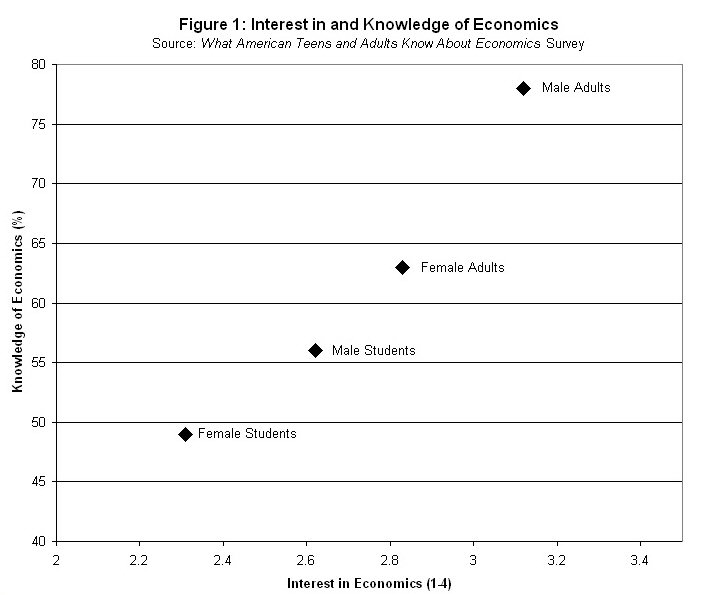
I just submitted my latest paper, “The Gender Gap of Economics: Why Do Men Think More Like Economists?” to Social Science Quarterly. Unfortunately, in order to get under SSQ’s 30-page limit, I had to cut my favorite figure. Here it is:
This figure, derived from the National Council on Economic Education’s What American Teens & Adults Know About Economics survey, shows the relationship between how interesting people think economics is and how much they know about it. Notice that the rank order matches up neatly: Male adults know the most about economics and are the most interested in it, followed by female adults, male high school students, and female high school students.
The simplest explanation is that men know more about economics because they find economics more interesting than women do. Admittedly, I’ve got no proof of causation. But as far as I know, this is the strongest evidence that the simplest explanation is viable.
READER COMMENTS
ben
Jul 5 2006 at 2:53pm
watch out, you could get Summerizerd
ben
Jul 5 2006 at 2:54pm
sorry for that typo, *Summerized
aej
Jul 5 2006 at 5:44pm
I wonder a bit how much presentation of introductory materials contributes to this. I took an econ course in High School which was mostly macro-GDP crap and entirely forgettable.
My choices indicate that I am a somewhat atypical female, but when I speak to other women about economics, I don’t find a lack of interest. If anything I find a horrible misunderstanding of what economics is (although this is routinely true of men as well). Once we talk a bit, they’re usually very excited and wonder why econ was never explained in those terms before.
Omer K
Jul 5 2006 at 7:19pm
Economics like most other disciplines has been far removed from the reality facing most students. One of the fundamental flaws of the edukation system.
Daniel
Jul 5 2006 at 7:52pm
aej, I think you’ve got some insight there. I know that in my own field, computer science, the dearth of women seems to be in no small part due to the presentation of the subject. I had one highly analytical woman – who did well in CS classes in high school – tell me that the reason she didn’t consider the field as a profession was because of her image of programmers as a bunch of overweight geeky men with no lives. I think that if the subject had been presented to her (and her female peers) on its own merits, the gender ratio in IT would be closer than the 20:1 or so that it is. Most technical and ‘hard’ scientific fields seem to suffer from similar cultural biases, and I’m not surprised that it applies to economics as well.
Now, how much that really affects the subject, I don’t know. Maybe there’s something in womens’ brain chemistry predisposes most of them toward disliking economics and IT, maybe there isn’t. But the cultural hump has to be overcome before we can totally explore it.
blink
Jul 5 2006 at 7:54pm
This is fascinating. I think you convincingly refute Burgoon and Hiscox’s hypothesis. I have a small quibble with phrasing of the last line in the abstract, however, which caused a double-take:
“The simplest explanation for these patterns is that men find economics more interesting than women, and therefore learn more economics per year of education.”
Really?! Men find economics not just more interesting than cake and ice cream, but that too? (At the end of Section I, you write: “…men find economics more interesting than women do,” which erases the humorous ambiguity.)
aej
Jul 5 2006 at 9:59pm
Omer K
My best guess is that unequal distributions of men an women in high level hard sciences will persist for some time. Brain chemistry is likely part of it–take the same woman and give her spatial orientation and verbal tests throughout her montly cycle and you’ll find a correlation between verbal/estrogen and testosterone/spatial abilities. But I do think the difference in numbers is exasterbated by many factors, the most basic of which is math education. My gut tells me that the terrible math education in this country disproportionately affects young women (not to mention the preponderence of example/picture based texts with little or no verbal explantions). There are so many intelligent women who enter the sciences and find their biggest stumbling block is a wobbly foundation in mathematics/problem solving. Be certain their daughters won’t be similarly disadvantaged.
Chris Stiles
Jul 6 2006 at 7:32am
Or .. clearly economics is a form of autism.
Timothy
Jul 6 2006 at 9:26am
I think aej makes a good point about introductory materials. My girlfriend refuses to understand opportunity cost because the first example in the first econ class she took was some ridiculous hypothetical about two neighbors and an apple tree. She explained it to me, and it was one of the most ass-backwards and ridiculous opportunity cost examples I’d heard, although I forget the details now. I mean, how hard is it to say “your opportunity cost is the value of your next-best alternative” and then make an example about banking and the COF?
I got lucky and had a very good professor and then TA for my first two courses and it made me love the discipline. I can say, as a recent college graduate, that the number of good looking girls in an econ class is inversely proportionate to its level. Intro micro? About 30% of the class, because the UO journalism school required it. Advanced macro? None.
nr
Jul 7 2006 at 7:35pm
What’s been overlooked in all the comments is what the graph conceals. Given the general ignorance of economics in the population, the score of over 75% for “knowledge of economics” for males implies that very little separates any of the four categories.
Comments are closed.