
Economists and the public systematically disagree; but can they at least agree about which problems are bigger than others? To check, I returned to the Survey of Americans and Economists on the Economy. (Yes, I do talk about this survey a lot; but in many ways, it’s unequaled).
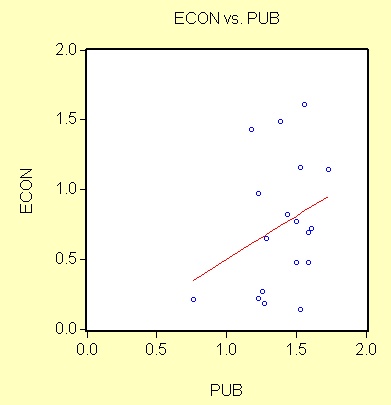
The first 18 questions have respondents rank the severity of various putative economic problems. So I took the public’s and economists’ average responses (0=not a problem; 1=minor problem; 2=major problem) and looked at the correlation. It’s actually moderately positive, r=.30. Here’s the graph, with regression line:
So while there are systematic disagreements question-by-question, things could be worse. We can imagine a world where the public’s “leading problems” are predictably economists’ non-problems, and vice versa. But that’s not the world we’re in.
I should add, though, that when you expand the sample to include all 37 questions in the SAEE*, the correlation turns slightly negative.
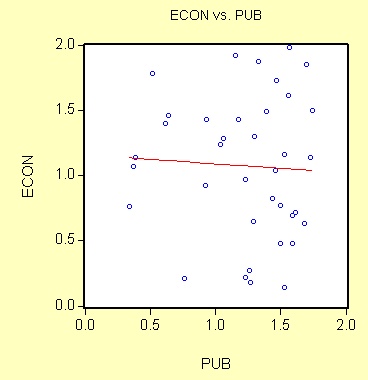
So even though there’s some agreement between economists and the public about how which problems are bigger than others, the general pattern is that you can’t predict the public’s views from economists’ views. I wonder why one would be different from the other. Any ideas?
* Three questions were re-scaled to fit on a 0-2 scale.
READER COMMENTS
RL
Aug 29 2008 at 5:02pm
From the first graph, it seems the “problem” is that the public thinks everything is a problem, while economists recognize that at least some things are not problems.
Eli
Aug 29 2008 at 5:25pm
It looks like the results of your first regression are driven by one outlier in the lower left corner. Try a robust regression to see if that doesn’t get rid of the correlation.
pushmedia1
Aug 29 2008 at 5:38pm
I bet the first results are highly dependent on that data point in the bottom left of the chart. What is it?
Justin Ross
Aug 29 2008 at 8:39pm
It’s not clear to me that things would be worse if the public and economists disagreed on these topics. Anything that has the ability to be influential to actual outcomes seems to be pretty badly infringed upon by poor government policy at the public’s demand. Economists don’t seem particularly interested in things that don’t matter a whole lot, so if the public demanded bad changes on topics that don’t matter there might not be as much harm. I guess it would have to be an empirical question.
Troy Camplin, Ph.D.
Aug 29 2008 at 9:16pm
Economic thinking is counterintuitive — at least, until it’s explained, when I then typically hear “Oh, well, that makes sense” — and that is reflected in the slight downward trend.
Les
Aug 30 2008 at 7:09am
If untrained laypeople were asked to perform brain surgery or rocket science or biophysics, would one expect to see any correlation between their actions and those of experts? Clearly not.
Then why would one expect any correlation between the opinions of the public and those of expert economists?
Especially when the media have such an impressive record of “always in error, seldom in doubt” on economic issues.
Jason Malloy
Aug 30 2008 at 8:08am
The difference between economists and the general public appears to be that ordinary people interpret the economy through what is perceived directly, while economists interpret it abstractly, as remote (i.e. not directly perceivable) processes.
So for instance, question 29+30: the general public believes that outsourcing and downsizing are two of the biggest threats to the economy, while almost no economists agree. In both cases it’s easy and automatic for people to interpret someone losing a job as a Bad Thing, because the pain is visible and connected to the firing in an obvious cause and effect fashion. (i.e. it is obvious a person is now sad and broke because they got fired)
What isn’t obvious or causally perceptible is that the elimination of jobs often means greater productivity, which means more profits, which means even more jobs can be created. Also not casually perceptible are the benefits of reduced prices that are spread across millions of people.
When negative causes and effects can perceived, but positive ones can’t be, this results in zero-sum thinking, as in questions ‘l’, ‘m’, ‘o’, ‘p’, and ‘q’.
If a downsized job goes to a foreigner (‘p’) or a robot (‘o’), people generally interpret that to mean one job has simply been redestributed, as if the number of jobs is static and finite. But if the job transfer results in more output per input the company might grow and expand, resulting in two or three new jobs for nationals.
Other examples are that the general public believes that the economy is hurt by high business profits and high CEO pay. This time money is the static and finite good. If some people are poor, it’s because other people have more than their fair share of what’s available. A “good economy”, is simply interpreted as when this finite amount of money is distributed around in more equal amounts.
Radford Neal
Aug 30 2008 at 8:59am
The plots so effectively no correlation between the expert views and the general public’s views. So wouldn’t it be more accurate to describe this as “economic ignorance”, rather than “economic bias”? You provide no evidence here that the public’s views are due to systematic biases rather than lack of knowledge.
Troy Camplin, Ph.D.
Aug 30 2008 at 9:40am
Bias is almost always due to ignorance.
Mike
Aug 30 2008 at 10:39am
It seems pretty clear that the correlations are not significant. The results are more of a random cloud of points than a trend. You should look at the uncertainty estimate and not just the best estimate. For the first one you say r = 0.3, but r = 0 almost certainly can’t be excluded by those data. (And as others have said, the nominal correlation looks like it’s coming entirely from that one point.)
Kubi
Aug 30 2008 at 10:55am
RL: That is exactly what stood out for me on the first graph as well. Basically, everything is perceived to be a problem, and problems naturally lead to demands that somebody “do something” to fix them.
Matt
Aug 30 2008 at 2:35pm
One idea, economists are willing to lie for their political patron. Doctors, and carpenters are not so willing. Hence, the public is confused.
Bill Nichols
Aug 30 2008 at 2:42pm
I see no correlation. When a data set has a single point outside a cluster, the best fit will always go through that point. The farther the separation from the cluster, the stronger it’s influence. The fit is insensitive to the slope of line through the cluster, and it will tend toward the middle to minimize the sum of the residuals, but it’s highly sensitive to that one point. That point will drive both the slope and intercept, the regression coefficients will be misleading and the correlation coefficient overly optimistic. Remove that point and r-square goes from 0.09 (weak) to probably about 0.0.
fundamentalist
Sep 1 2008 at 6:31pm
The public disagrees with economists because economists aren’t the only source of information on economic issues for the public. On complicated issues, especially those that don’t affect them personally, the public relies on experts for information. They follow an efficient division of labor. They don’t have the time and know they don’t have the expertise to investigate economic issues. So they rely on experts. Often those experts are the talking heads on television.
It is well known that most university professors outside of the business school and econ classes are heavily socialistic. That’s especially true of history, English and journalism. Few journalists ever take a class in economics or business, but get huge doses of socialism in their humanities and social science classes. As a result, they distrust free market economists. That socialism filters their presentation of the news and opinion pieces.
In addition, Hollywood is clearly very socialist oriented. Movies and TV shows constantly pound socialism into the heads of viewers. And actors support socialist causes and praise Castro.
Free market economists, on the other hand, rarely appear on TV, except on C-Span, and never in movies. They write articles for journals that only other economists read, a few blogs that only us econ wonks know about, and obscure books.
The wonder isn’t that the public disagrees with economists. The wonder is that there are any free market tendencies left at all among the public. I believe that if left to the public, the US would soon become a Soviet style socialist state. A few politicians trying to uphold the Constitution are all that prevent it.
If free market economists want to influence the public, they need to quit talking to each other and talk to the media gatekeepers who have access to the public and influence their thinking.
Troy Camplin, Ph.D.
Sep 2 2008 at 7:44am
Really, it’s the job of the artists to educate the public at large. That’s the only way people are going to understand truly complex concepts. Unfortunately, nobody takes that fact seriously, and the artists have been abandoned to the Left.
Rich
Sep 2 2008 at 9:54am
Surely you would see a completely different regression result using PUB as the dependent variable, right?
Milky Way
Sep 7 2008 at 5:01pm
The answer is simple: economists are incompetent. It’s so obvious that I would have difficulty hesitating to call your name.
Do you think the public would have systematic bias against, say, the parabolic curve? Or some basic physics theorems? (The public might have bias about advanced physics, that is something economists are good at explaining through the marginal door.)
Economists suck. That is the answer. The one that does not is Hayek (with his essay: the use of knowledge in society). Scholars suck. The exception is Socrates when he said those famous sentences. Bias, consensus, those, the frequencies of those words used by experts to justify their profession are the signs their profession sucks.
Again, the subject matter of economics is deadly serious. (As pointed out by Herbert Simone and others: it’s hard science.) The slow progress of economics is not satisfying. That’s OK. The stupidity is that you think the responsibility is not the alchemists’ but those of the public. You’re not treated as chemists because you’re not. Can you look into the mirror for God’s sake!
Comments are closed.