
Categories:
Family Economics
From Will Wilkinson, in a 100+ comment discussion at Overcoming Bias:
I would guess that number of children is negatively correlated to number of sexual partners.
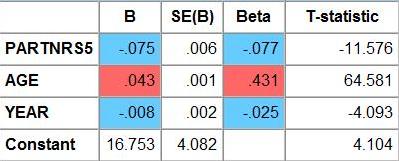
According to the General Social Survey, Will’s guess is… correct! The correlation between number of children and PARTNRS5, its best measure of total number of sexual partners, is -.26.
This result holds up in a multiple regression that controls for age and the year in which the question was asked:
Nice guesswork, Will.
* Note: Here‘s how the GSS codes responses for PARTNRS5. To make the variable monotonic, I only counted responses from 0-8.
READER COMMENTS
John Jenkins
Sep 26 2009 at 1:35am
Isn’t there a logical problem here?
If we assume that those who are married are less likely than those who are not to have had multiple partners over the last five years, aren’t you really just showing that if one is married one is more likely to have more children than if one is single?
Maybe age serves as a proxy here, but not necessarily. Is there a way to control for marital status?
(You already pointed out the fact that this particular variable shows only a five year window, so doesn’t really measure total sexual partners. I don’t think controlling for age fixes that problem.)
HispanicPundit
Sep 26 2009 at 1:35am
Why are you impressed? That seems pretty obvious to me and probably many alphas of the world.
RL
Sep 26 2009 at 1:35am
Is the database restricted to heterosexuals? Is the database restricted to men (as I could easily imagine women with more sexual partners having more children)?
RL
Sep 26 2009 at 1:37am
Is the database restricted to heterosexuals? Is the database restricted to men (as I could easily imagine women with more sexual partners having more children)?
razib
Sep 26 2009 at 1:44am
don’t ask bryan to do your work for you, do it yourself:
http://sda.berkeley.edu/cgi-bin/hsda?harcsda+gss08
but last i heard it applied to women too.
Steve Miller
Sep 26 2009 at 6:32am
I would guess that number of children you don’t know about is positively correlated with number of partners.
Scrutineer
Sep 26 2009 at 10:18am
Audacious Epigone and Inductivist wrote about this a while back.
Jason Malloy
Sep 26 2009 at 4:31pm
Epigone also looked at women. And Inductivist also looked at trends over time.
Dr. T
Sep 26 2009 at 7:31pm
I would guess that number of abortions is positively correlated to number of sexual partners.
Sex with multiple partners = more STDs and more pregnancies.
Pregnancies + no steady parters = more abortions and fewer births.
I did my OB/GYN clinical clerkship in a Brooklyn neighborhood that was becoming a slum. I don’t need survey data to know that the above statements are correct.
Comments are closed.