
Categories:
Family Economics
Public Goods
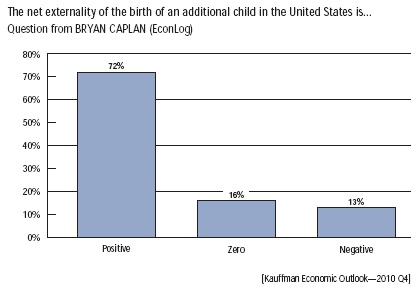
The Kauffman Foundation’s Tim Kane generously included one of my questions on the latest quarterly econ blogger’s survey:
The net externality of the birth of an additional child in the United States is… [POSITIVE, ZERO, or NEGATIVE]
Survey says:
I suspect that left-wing economists are underrepresented in blogging, and would be a lot more likely to answer “zero” or “negative.” But economists’ acceptance of the Julian Simon position is still amazingly strong. I expected more like 40/40/20.
READER COMMENTS
Don Boudreaux
Oct 27 2010 at 3:11pm
Go Bryan!
John Thacker
Oct 27 2010 at 3:51pm
Considering the responses for the party identification (page 11: 9% described themselves as registered Republicans, 21% as registered Democrats, 31% as Independent/Others, and 39% declined to describe themselves politically), I’m unclear exactly how underrepresented left-wing economists are. I suppose you do have good data on this, given your book– and a lot of the Democratic economists do tend to be “center-left” Democrats.
Jacob Hedegaard
Oct 27 2010 at 3:54pm
On another note but within the same survey:
Isn’t there a discrepancy between how EconBloggers feel about global output, Inflation etc. and how they consider the chances of double dip?
Mo
Oct 27 2010 at 4:35pm
I think you meant something like 60/20/20 right? 40+20+20=80
Peter Finch
Oct 27 2010 at 4:36pm
Given the controversy that arose when Bryan suggested that most babies are adding value, it would be interesting to ask “What fraction of births of an additional child in the United States have a positive net externality?”
I think the fraction is pretty high, but I’d like to see data on economist’s thoughts, and I’d like to have the issue analyzed more systematically. I have the impression from the comments on this blog that “the fraction of babies with positive externalities is high” is not the majority opinion here, irrespective of beliefs about the average externality.
I was disappointed by the immigration presentation, which I thought was less data-driven than the critiques in the comments. This seems like an easy place to use numbers, not philosophy.
David Friedman
Oct 28 2010 at 2:42am
I tried to calculate the externality a very long time ago, and concluded that I couldn’t even sign it.
Of course, both the sign and the magnitude of the externality are going to be different for different children. For mine the externality is positive and large.
Peter Finch
Oct 28 2010 at 9:35am
@David
Thank you for the reference. It’s nice to see someone who has tried to count.
As a first cut, I would compare the bottom decile of GDP per capita to 1/300,000,000 of government expenditure, making sure to count expenditures at all levels (Federal, State, Local), including entitlements. I’m not sure the first number is easily found.
You can argue about the evenness of distribution – poor folk get more from Medicaid, but less from defense – and stuff that’s not easily measured like carbon footprint or extra happiness to relatives or the inefficiencies introduced by regulation.
Brian Moore
Oct 28 2010 at 10:13am
I’d say that this is an instance where people’s instincts overwhelm whatever they might think they believe (positively, in my opinion). I bet if you showed a picture of a baby with the poll question it’d go even higher.
Comments are closed.