
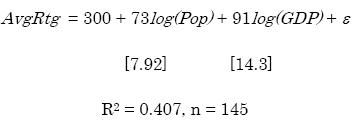
Population doesn’t just predict Olympic gold medals and movie production; it also predicts the average ranking of countries’ top-ten chess players. In a multiple regression, population and per-capita GDP both matter, just like Julian Simon and New Growth Theory tell us to expect:
HT: Tyler, of all people
READER COMMENTS
Zippy
Jun 4 2011 at 2:00am
And per capita GDP is directly correlated with IQ.
Steve Roth
Jun 4 2011 at 9:19am
Again, I’m really confused here: why is this interesting? If a country has more people, one would expect it to have more of everything, including (successful) chess players.
“between 17% and 40% of a country’s chess success can be explained in terms of its population and GDP [per capita] (adjusted for cost of living)”
Isn’t the remarkable thing here that the correlation so low? All other things being equal, wouldn’t you expect a correlation of 1 between population and number of successful chess players (or, hence, the average rating of the top X players in a country)?
This is why big-school teams play in different leagues from small ones.
“Grandmasters are clearly unevenly distributed across the world.”
This is news? We should alert the media?
I feel like I must be stupidly missing something obvious. Help?
ziel
Jun 4 2011 at 10:22pm
Bryan seems to be proposing that raw population is a driver of good things like innovation, technological progress, and idea generation. This conflicts with the “Smart Fraction theory“, where the proportion of the population that is really smart is what matters.
For example, Egypt at 80 million people and average IQ of 85 can be expected to have around 80,000 people with a 130+ IQ; while Switzerland, with 8 million people but an average IQ of 100 should have around 150,000 people at or above 130 IQ. My guess is the Smart Fraction theory has more explanatory power than the raw population theory without looking to much more deeply into it.
Zippy
Jun 5 2011 at 7:23am
Bryan won’t even consider the “smart fraction” theory, because it suggests that America is better off screening for intelligence, rather than letting in a bunch of random Third Worlders.
But I’m sure he can point to all those high-tech companies founded by Mexican immigrants.
hacs
Jun 6 2011 at 11:28am
Could ethnic diversity and immigration be relevant in this equation?
Comments are closed.