
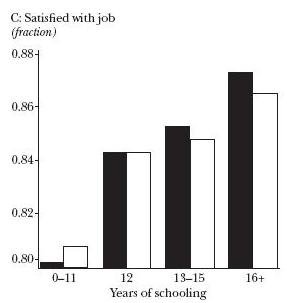
I won’t deny that there’s a lot of interesting material in “Priceless: The Nonpecuniary Benefits of Schooling” (Oreopoulos and Salvanes 2011, Journal of Economics Perspectives). The theme, of course, is that the benefits of schooling go far beyond mere extra income. I was struck, though, by the tiny effect of education on job satisfaction. Take a look at the fraction of people who are fairly, very, or completely satisfied with their jobs as a function of education:
[The black bar shows the raw result; the white bar holds income constant.]
Dropouts are just 7 percentage-points less satisfied than college grads? Hmm.
But what happens if you treat the GSS’s original 1-7 scale (1=”complete satisfied”, 7=”completely dissatisfied”) as a continuous variable? I expected to see a bigger effect of education, but I was wrong. The correlation isn’t just statistically insignificant; it reverses sign, with every year of education predicting a score .006 higher (=less satisfied). Controlling for log income, education actually predicts noticeably lower job satisfaction:
READER COMMENTS
nazgulnarsil
Jul 9 2011 at 9:15pm
more specialized labor = more alienation? Marxist thoughts feel icky.
Peter H
Jul 9 2011 at 10:12pm
Unrelated to your continuous variable analysis, but their graph itself is really disturbingly deceptive. It is one of the worst offenders of the Y-axis scale trick I’ve seen in a while. Putting the 0-11 year cohort as a nearly invisible bar while having 16+ be gigantic, when in reality the differential is only about 8% of the height of the top bar if taken from a 0 base.
(I checked by the way and it is Oreopoulos and Salvanes’ graph, not Bryan’s)
blink
Jul 9 2011 at 10:16pm
I would like to know whether the effect is driven by highly educated who feel they are working in jobs that do not utilize their skills. We might see that folks working in jobs that require additional schooling are much happier, though well educated folks working in unskilled jobs are especially frustrated. A quick test would be whether variance increases with education.
Batjik
Jul 10 2011 at 1:06am
Maybe it’s because English and Sociology professors spend entire classes telling their students that working (contributing to society) is “wage slavery”?
Dominik
Jul 10 2011 at 7:32am
I’ve redone the graph without distorting the vertical axis:
http://img837.imageshack.us/img837/4034/jobsatisfaction.png
Mik
Jul 10 2011 at 6:26pm
I am not sure “pricless” is entirely correct (even though the effects discussed in the paper is very difficult to monetize – perhaps impossible?). But, it shows that all the discussion on this blog (and others on this topic) where economists talk about the “social return” to education is nonsensical. Before having a grip of all these non-pecuniary effects (causal, the monetary value etc.) please admit that you are ignorant as to what the social return of education is. Hence, whether or not society today “over-educates” people is not something that can be answere with the data that is out there…today at least.
Kendall
Jul 10 2011 at 8:43pm
My experience as a teacher is that students who continue their education are the students who have the desire and ability to do jobs which require further education and those who don’t often are quite happy with jobs which don’t require further education. It seems to me the goal should be to have a system which makes it possible for people to be able to get the education they need to perform the job they want at the lowest price.
Will
Jul 11 2011 at 2:07am
Perhaps its that the more education you have the more likely you are to be overqualified. After all, we’ve seen a pretty drastic hollowing out of the job market.
I’ve never once had to use any of the physics I spent years learning during my undergrad and phd on the job. I’ve been in this job for 4 years, and I’ve spent 20% of my time every day looking for work that actually involves doing some science. I don’t hate my job, but my satisfaction isn’t particularly high, either.
Jacob Oost
Jul 11 2011 at 3:29am
With all due respect, “years of education” is too broad a metric to mean much…if various *kinds* of education result in widely differing job satisfaction rates, i.e. if engineers and computer programmers have much higher job satisfaction than social workers or office drones or whatever…and I very much suspect that to be the case.
Daniel
Jul 11 2011 at 10:50pm
What happens is that you get taunted by econometricians who went to / work at…how shall I put this…a more quantitative schools than GMU.
BWHAHAHA!!!
OK, ribbing aside (you = Princeton, me = University of Colorado at Boulder), why would you do such a thing?
Comments are closed.