
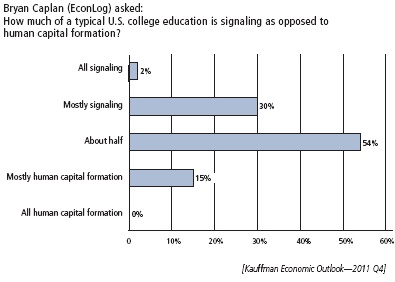
My confidence in the empirical importance of the signaling model of education generates a lot of pushback from my fellow economists. For starters, see my arguments with Bill Dickens, Tyler Cowen, Karl Smith, and Arnold. Which got me wondering: How alone am I?
The Kauffman Foundation’s Tim Kane gave me the chance to find out on the 4th Quarter econ blogger survey. My question – and the results:
The Kauffman write-up also includes the following comments:
Possibly. But as Kauffman often points out, its sample of econ bloggers is pretty representative of the overall economics profession. All things considered, I now suspect that the pushback I’ve experienced from my peers reflects a vocal minority rather than a stubborn consensus. That’s excellent news for me: It’s far easier to be the guy who says the Truth that Dare Not Speak Its Name than the Lone Nut.
Any other evidence on the consensus on signaling that I’ve missed?
READER COMMENTS
Tyler Cowen
Nov 2 2011 at 3:26pm
Virtually all current published work relies on the human capital-based explanations…?
rapscallion
Nov 2 2011 at 4:20pm
Tyler,
Are you referring to the personal return-estimation literature? I don’t think that’s true. I’ve read several Heckman papers where he admits to being agnostic as to whether or not the returns he’s estimating are due to signaling or human capital. I can find quotes if you are really doubtful.
David R. Henderson
Nov 2 2011 at 4:32pm
Bryan,
Your link for the survey doesn’t go to the survey.
English Professor
Nov 2 2011 at 7:32pm
For a lot of college students, there simply isn’t a lot of gain in human capital. As I noted in response to the post on The Great Stagnation for Colleges, the average college graduate lacks strong analytical skills and writes poorly. That’s why I suspect that the “signal” of a college degree is actually weakening. In fact I expect the premium for workers with a college degree to drop over time. Those with degrees in more demanding fields should do well, as well as students from more prestigious universities (because they had to demonstrate earlier achievement simply to get admitted). But for students in the bottom half of the distribution (defined as those with flabby majors from mediocre to weak schools), I would expect the premium to decline sharply, if not disappear.
joeftansey
Nov 2 2011 at 11:24pm
Bryan Caplan claims that diplomas help signal conformity. How does he know that conformity isn’t learned? That it isn’t a product of decades of education?
I can think of some less-intensive signalling tests for conformity…
Bryan Willman
Nov 3 2011 at 1:33am
Would the next person to do a survey please frame it more like this:
“For STEM fields, pre-med, and pre-law: what part of a college degree’s value is signalling, what part human capital formation…”
“For other fields….”
Blake Johnson
Nov 3 2011 at 2:33am
I suspect it would still be quite a bit. I know quite a few law and med students, and the kind of stuff they do there is often pretty unrelated to the stuff they do for the undergraduate degrees. How much does reading Heidegger and studying Metaphysics relate to case studies of corporate law in the 1950’s? It seems plausible that the undergraduate degrees signal that students are of a certain type ,which generally has more success in these difficult fields.
The real question is what part of the med degrees and law degrees are signaling. My guess is still a fair amount.
John Thacker
Nov 3 2011 at 9:31am
It’s still possible to make a distinction with this between pure signaling qua signaling and “working on something difficult to develop useful habits, even if you don’t use it directly,” i.e. the (perhaps discredited) theory that Latin teachers like.
Ben Wildavsky
Nov 3 2011 at 9:50am
Don’t the positive economic returns associated with even a year or two of college (higher earnings, lower unemployment) significantly undermine the signaling theory? Unless you believe that employers view having “some college” — in the same way they allegedly view earning an actual degree — as itself a signal of pre-selection, sticktuitiveness, or somesuch. Seems to me that human capital development is a far more likely explanation.
joeftansey
Nov 3 2011 at 10:42am
At the University of Texas, a degree in petroleum engineering is approximately 75% signalling 25% real learning. The part that is real learning could easily be completed in about a year and is FAR less demanding than the other 75%. The real learning involves understanding what things like permeability and viscosity are. The “inapplicable” signaling part involves deriving equations and writing computer programs.
Komori
Nov 3 2011 at 4:46pm
I agree with the comments that it depends on the degree subject. Something like Electrical Engineering will have a significant component of human capital formation. A degree like minority-of-the-moment studies will have little. Based on my exposure to its contents, an education degree will not only be entirely signaling, it will be actively destructive of human capital.
Walter Sobchak
Nov 4 2011 at 11:48am
You can lead a horse to water, but it takes a lot to drive him to drink.
Colleges provide some opportunities for human capital formation. The door may be open but the student has got to walk through it. Also, the schools are perfectly content to allow the students to skate for four years on a curriculum of human reproductive biology by braille, and practical applied zymurgy experiments.
Right now it is like hoping a hurricane will water your lawn. Far too expensive and damaging to be of any real utility.
Comments are closed.