
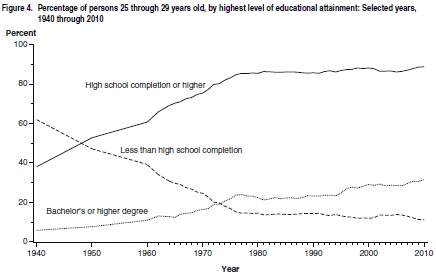
Why has the return to education increased so much in recent decades? The simplest explanation is that the supply of well-educated workers just isn’t keeping up with the demand. Indeed, many claim that American educational attainment has been stagnant for decades. This figure from the 2010 Digest of Education Statistics seems to back the stagnationists up:
There’s just one problem: This figure isn’t for American educational attainment in general. It only shows attainment for 25-29 year olds. The first figure shows a flow, not a stock. The next figure shows attainment for the whole population:
Last question: What determines the supply of labor? Is it the flow of workers, or the stock? The answer, of course, is the stock. The bottom figure isn’t a perfect measure of the stock of workers; you should probably remove retirees. But “Americans 25 years and older” is clearly a much better measure of labor supply than “Americans 25-29 years old.”
Bottom line: Educational stagnation is probably coming soon. But contrary to many, it hasn’t happened yet.
P.S. Coming soon: Goldin-Katz and the education plateau.
READER COMMENTS
Arnold Kling
Mar 1 2012 at 11:48am
Go back to Goldin and Katz. As I recall, they look at labor force cohorts. I worry that looking at people over 25 distorts the picture by including retirees. The low-educated people who are dying out are people who aged out of the labor force 15 years ago or more.
CKE
Mar 1 2012 at 12:06pm
“The first figure shows a flow, not a stock.”?
Both figures show a stock. The first figure is showing a subset of the second.
The flows into the different stocks are the same: people turning 25. However, the flows out are different. In the first figure, people flow out when they hit 30. In the second, people flow out when they die (or leave the US?).
But you are correct in that the second figure contains people who grew up at a time with lower education levels. As these people flow out, the average will rise and plateau at the level of the first, if no one beyond the age of 29 finishes high school or goes to college and deaths and migration are evenly distributed among the educational groupings.
Jack
Mar 1 2012 at 12:09pm
Yes, but if the figure for 25-29 yr olds plateaus at about 85% (eyeballing the graph) and we are currently at 80% for age 25+, we are certainly approaching the plateau. Still, your point is very astute.
Ben
Mar 1 2012 at 12:32pm
Please see the James Heckman and Paul LaFontaine paper on public high school graduation rates over time. http://www.nber.org/papers/w13670
I believe the second graph you display counts GEDs as high school graduates. Research by Heckman and others indicates that GEDs and actually graduating from high school do not yield the same returns in the labor market. GEDs earn less, all else equal.
Heckman and LaFontaine separate out GEDs and find that the percent of Americans with a high school degree or higher peaked around 1970.
Gerald
Mar 1 2012 at 5:48pm
This appears to be a quantity analysis without regard to quality. I don’t think many observers would assert that the quality of high school education or college education is comparable to earlier years. So, even if there are more “graduates”, it is questionable whether their readiness to contribute value to the labor market is equivalent to earlier years.
John
Mar 1 2012 at 6:03pm
Hmmm. We start with the question “Why the return to education?” and a proposed answer: relative scarcity, which presumably has been increasingly scarce.
We then show the scarcity argument fails.
…
What’s the conclusion suppose to be here?
(My personal suggesting is that it’s something of a bubble result that’s reflective of both the Greenspan era equity bubbles as well as the more recent bubble that has so impacted the housing markets. Any takers on a hypothesis that return to level of education starts to see problems?)
Donald A. Coffin
Mar 1 2012 at 9:10pm
And here I thought economic analysis was about marginals, not about averages…
Hannes
Mar 2 2012 at 4:02am
It seems that you attack a straw man in the following sense. If the claim was that plateauing education lead to an increased education premium, there is already an implicit assumption in that statement that demand for well-educated people is steadily growing over time.
If wages for highly educated people was only a function of the stock, a plateauing education attainment even in the total population should not affect earnings.
The idea must be, which is very much implicit in Goldin and Katz’ title “The RACE between …” , that there is a secular increase in requirements of skills over time. Therefore, the skill of workers have to increase all the time to keep the wage premium constant. Over time, the old workers which the young are about to replace will have a higher skill level, and to maintain the time derivative of skill level in the work force, the skills of young people have to be continually improved.
The consequence of the plateauing in your first graph is that the derivative is decreasing in the second, and if you assume a roughly constant increase in demand for skills, this will push up the skill premium and the driving force is the plateauing of young people’s education.
John Ray
Mar 8 2012 at 2:24am
Both graphs show the rise of credentialism, nothing more
Comments are closed.